GMGN Perpetual Futures (Beta): Fees, Margin and Liquidation
How we verified this
- Last checked by hand
- September 29, 2026. Every statement about GMGN's perpetuals below was read against GMGN's Perpetual DEX Terms, its GMUSDC Terms and the live app on that date. Launch coverage is labeled as press wherever it is used.
- Checked against
- Who checked it
- Concept211 (@Concept211), who writes and maintains this site. It is a one-person publication with no relationship to GMGN. A figure we could not reach a primary source for is labeled unverified on the page instead of estimated, and the re-check schedule is set out in the methodology. If something here looks wrong, tell us and we will re-check it.
Table of Contents
- What is GMGN's perpetual futures product?
- Which markets does it list?
- How do you get into GMGN perpetuals?
- Who is excluded?
- What does a GMGN perpetual trade cost?
- How do leverage, margin and liquidation work?
- Cross and isolated margin
- Leverage limits
- A worked example with the one number on screen
- What happens at liquidation
- What is GMUSDC, and what does the reward mean?
- Should a memecoin trader use GMGN perpetuals?
 GMGN
GMGN
GMGN built its name on spot memecoin trading. On September 21, 2026, several outlets reported that it had opened perpetual futures to the public as a beta (CryptoBriefing, TronWeekly, PANews). Those reports quoted fee rates, a market list and a reward rate.
This guide leaves those numbers out. As of September 29, 2026, GMGN's documentation site has no page about perpetuals at all. What GMGN has published is a Perpetual DEX Terms of Service, a separate GMUSDC Terms, both dated September 9, 2026, and the app itself. Everything below comes from those three sources. Where GMGN hasn't published a figure, this page says so and doesn't borrow one from a press release.
GMGN perpetuals are a web-only product with USDC as margin, cross and isolated margin modes, and an optional GMUSDC reward wrapper. GMGN has not published its fee schedule, leverage caps, maintenance margin rates, funding interval or settlement chain. Its terms say it does not have to give a margin call before liquidation. The US and China are among the jurisdictions its terms exclude.
What is GMGN's perpetual futures product?
A perpetual future is a leveraged contract that tracks an asset's price and never expires. You post margin, pick a direction and a leverage level, and the position stays open until you close it or it gets liquidated. GMGN's terms define its version plainly: "Perpetual Contract means a perpetual or similar derivative-style Digital Asset product made available through the Perpetual Trading Services."
The product runs separately from the spot terminal. Spot trading on GMGN costs a documented flat 1% per transaction, as covered in GMGN fees explained. Perpetuals run under their own terms, with their own margin currency and their own fee lines.
The terms describe the plumbing in general language. The service uses "off-chain trading and account infrastructure and blockchain-based or cryptographic settlement infrastructure." Deposits go into a "Vault," which the terms define as "any smart contract, vault or other blockchain-based infrastructure." Some state changes "may be subject to cryptographic proof" before they settle on-chain.
In other words, matching happens off-chain and settlement happens on a blockchain. The terms do not name the chain. They also don't name any third-party exchange as the venue, and none of the usual perp venue names appear in the app's perpetual code. So if you see a claim that GMGN perps run on a particular exchange, look for its source first.
Which markets does it list?
Pair names in the app follow the format BTC.PERP/USDC, ETH.PERP/USDC and SOL.PERP/USDC, so USDC is the quote and margin currency. GMGN hasn't published a full market list. Launch coverage named BTC, ETH, SOL and ZEC "and other markets," but that list came from press, not from GMGN.
How do you get into GMGN perpetuals?
The perpetual section is on the gmgn.ai web app. The interface text says it directly: "Perpetual Futures is only available for GMGN-login accounts." GMGN's Telegram bot list has no perpetual bot, so the Telegram-first setup in connect Telegram and fund a GMGN wallet gets you to spot trading, not perps.
The funding path is also different from spot, and so is the custody model:
- Deposits come from an external wallet. Section 6 of the terms says you "transfer supported Digital Assets from your external wallet to a Vault."
- GMGN says it does not hold that wallet's key. In the terms' words, GMGN "does not request or hold the private key or seed phrase to your external self-custodial wallet." That is the opposite of the spot side. There, GMGN's hosted trading wallets cannot export a private key at all, as covered in is GMGN safe.
- Withdrawals need your wallet's authorization, and GMGN "may require a withdrawal destination to correspond to a wallet previously connected, bound or otherwise verified" with your account. The terms also allow withdrawals to be delayed or rejected, and they mention a withdrawal fee disclosed in the app.
An external wallet signing deposits doesn't mean your USDC stays self-custodied once it's inside. It sits in the Vault, and the balance you see is what GMGN's account system reports. The terms treat the Vault separately from "the Account balances or Position information displayed through the Perpetual Trading Services."
Who is excluded?
Section 3 of the perpetual terms names the United States, China, Afghanistan, Cuba, Iran, North Korea and Syria as "Restricted Jurisdictions," plus any territory under comprehensive sanctions. It also says you must not use "a virtual private network, proxy, false location information or other means to conceal or misrepresent your location." When we read the app's interface text on September 29, 2026, its region notice also listed Hong Kong and Russia. That notice says "Trading, Reward, deposits and withdrawals are unavailable." The two lists don't match, and this page can't tell you which one GMGN enforces or what your local rules allow. If you're unsure, ask a professional where you live.
Read the order ticket before the first perp trade
GMGN shows the maker and taker rate in the app rather than in its docs. Open the perpetual section, check the rate, the leverage cap for your pair and the margin mode before you size anything. Not financial advice.
Open GMGNWhat does a GMGN perpetual trade cost?
Section 12 of the terms lists the fee categories: "maker or taker trading fees, withdrawal fees and other fees disclosed through the Services or applicable fee schedule." GMGN hasn't published that schedule anywhere we could find. The app doesn't hard-code a rate either. It loads the maker and taker figures from GMGN's server and shows them as "Taker / Maker" in the order form.
That's why this page doesn't repeat the taker and maker rates that ran in launch coverage. They may well be what the app shows. But a rate that only exists in press copy can change without any published record, and you can't check it against a document. Read the rate off the order form at the moment you trade, and screenshot it if the number matters to you.
The terms and the app name three more cost lines:
| Cost line | What GMGN's own materials say | Published rate? |
|---|---|---|
| Maker and taker fee | Charged per trade, "disclosed through the Services" | No. Shown in the order form only |
| Funding | "Not necessarily fees charged by GMGN"; can be payable even when price barely moves | No interval or formula published |
| Liquidation fee | A separate line in the app's realized PnL breakdown | No |
| Withdrawal fee | A "disclosed withdrawal fee" in the terms | No |
Source: GMGN Perpetual DEX Terms of Service, sections 10 and 12, and the gmgn.ai app interface, read September 29, 2026.
Funding is the cost with no spot equivalent. On a perpetual, longs and shorts pay each other at intervals to keep the contract price near the underlying asset. GMGN's terms say funding "may be payable even if the market price of the underlying reference asset does not move materially in your favor." The app adds that "in extreme markets, funding fee delays up to 5 minutes may occur." The terms defer the funding interval and formula to "Trading Rules." GMGN defines those as rules published "through one or more pages, interfaces or documents," which "need not exist as a single, consolidated document." We didn't find them published as a document.
One difference from spot works in your favor. The app's realized PnL on perpetuals "includes trading PnL, fees, funding fees and liquidation fees," so unlike spot PnL, the perp figure is meant to be net of costs. On the spot side, GMGN's PnL leaves fees out.
How do leverage, margin and liquidation work?
Cross and isolated margin
The app offers both standard modes. Cross margin pools all your cross positions against one balance, and the interface warns about it in its own words: "All cross positions share the same margin. In the event of liquidation, you may lose your entire margin and all cross positions." Isolated margin puts a fixed amount behind a single position, so a liquidation only takes that position's margin. There's also a "Multi-Assets Mode," which works only in cross mode.
If you're coming from memecoin spot trading, isolated is the more conservative default. A bad trade can't reach the rest of your balance.
Leverage limits
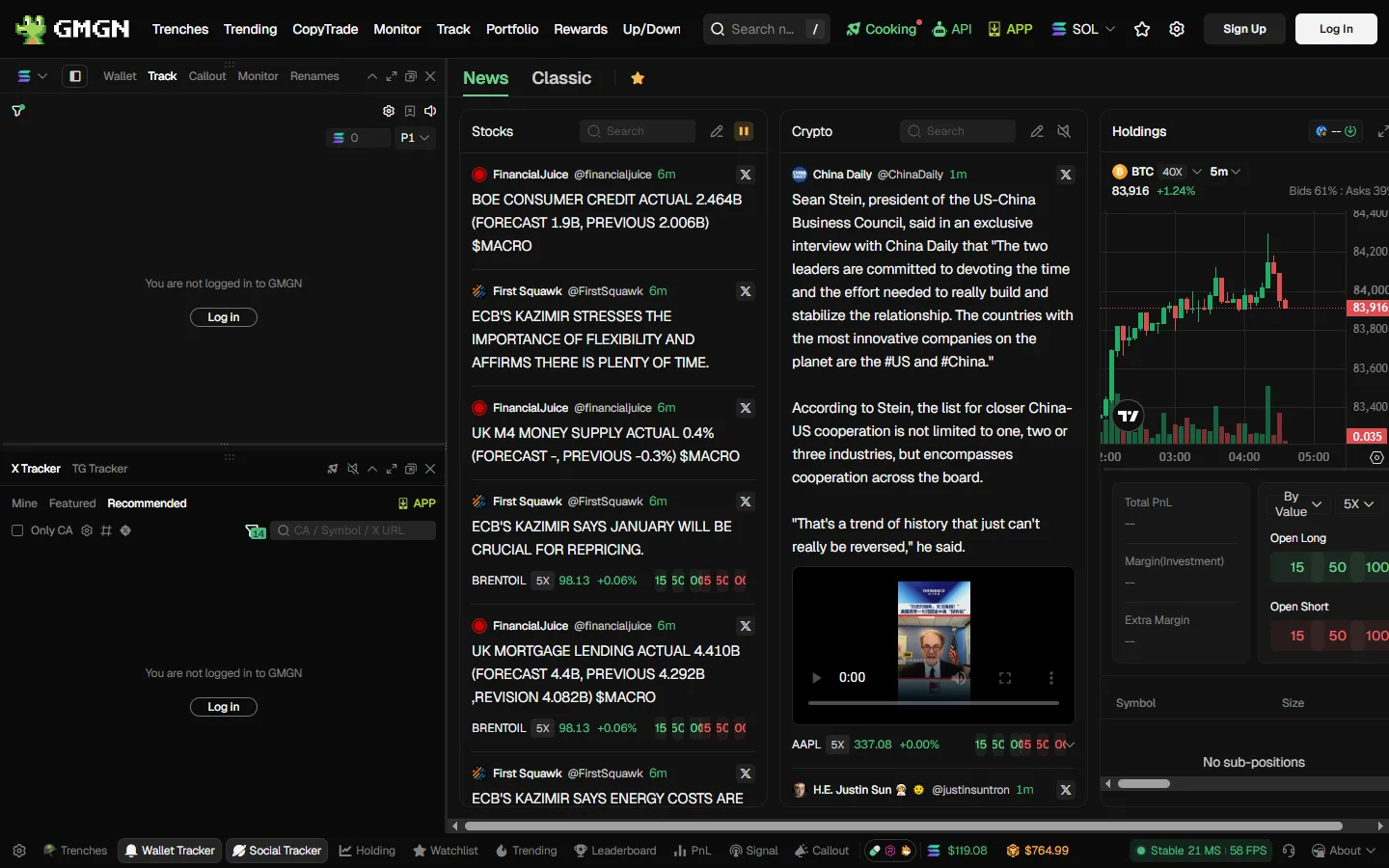
GMGN sets leverage per pair, and the app warns when an order "exceeds the maximum leverage for this pair". It has not published those maximums. The logged-out panel in the screenshot above shows a leverage selector reading 5X and a BTC label reading 40X. Those are interface defaults on one screen, not published limits, so don't plan around them.
A worked example with the one number on screen
Take the 5X shown in that panel and a round $100 of margin.
- At 5x, $100 of margin controls a $500 position.
- A 20% move against you on $500 is $100, which is all of your margin.
- Liquidation comes before that 20% point, at a level set by the maintenance margin rate. The maintenance margin rate is the minimum equity a position must keep open, and GMGN has not published it. Fees and funding paid along the way also push the liquidation point closer.
So at 5x, the most you can say from published material is that an adverse move of somewhat less than 20% closes the position. At higher leverage the room shrinks in proportion: at 10x a move of under 10% does it, and at 40x it's under 2.5%. On a volatile asset, a move that size can come and go before you look at the chart again.
What happens at liquidation
Section 11 of the terms is the part to read twice. Positions can be "reduced, closed, transferred, taken over or liquidated without further notice." To cover shortfalls, GMGN may use "insurance funds, position takeover mechanisms, automatic deleveraging or other procedures." Automatic deleveraging means a profitable position on the other side can be cut to cover a loss that liquidation couldn't absorb. And section 9 says GMGN is "not required to provide a Margin call or other notice before a Position becomes subject to liquidation."
Warning
No margin call means the first sign of trouble can be the liquidation itself. GMGN's terms call perpetual trading "highly speculative" with "a substantial risk of loss," and the app warns that "high leverage increases liquidation risk significantly." This is a beta product with unpublished margin tiers. Size positions you can afford to lose entirely.
What is GMUSDC, and what does the reward mean?
GMUSDC is an optional wrapper on your perpetual balance. When you switch on Mint & Rewards, USDC in the account "is continuously minted 1:1 into GMUSDC." Rewards accrue in 8-hour periods at a floating rate, and the minted balance stays "100% usable as margin." Switching it off redeems GMUSDC back into USDC.
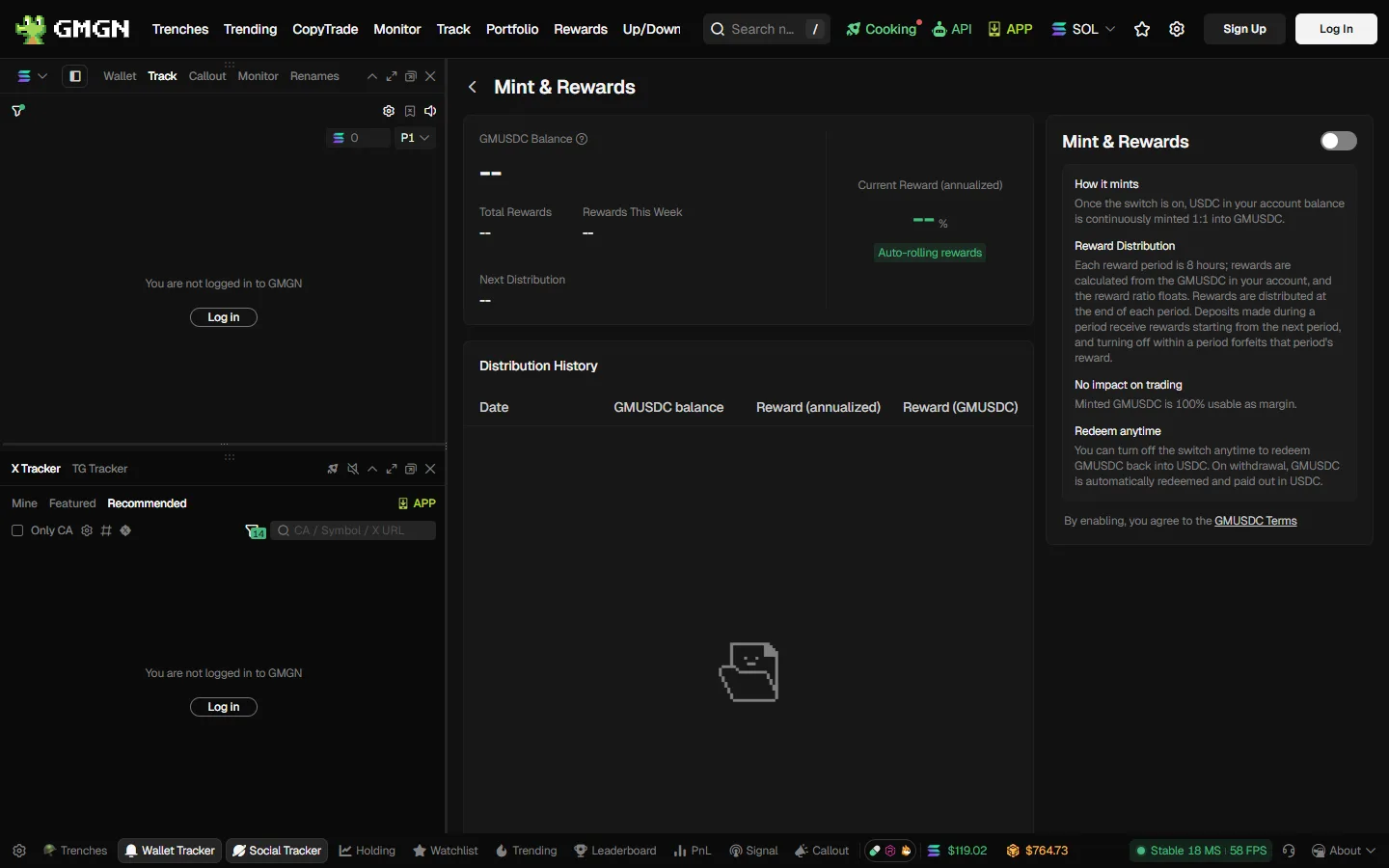
The GMUSDC Terms are where the detail is, and they deserve more attention than the reward rate:
- GMUSDC's "1:1 representation of your Deposited Assets is a contractual entitlement against GMGN only, and is not backed by an on-chain mechanism."
- Deposited assets may be moved to "addresses controlled by GMGN or its Affiliates, and might not be kept separate from other users' assets."
- In capitals: GMUSDC "IS NOT A BANK DEPOSIT."
- The reward "floats over time, and may change or be reduced to zero at any time without prior notice."
Launch coverage quoted a reward rate. GMGN's own screen shows the rate only to a logged-in account, and the terms say it can reach zero, so we don't quote one. To earn it, you swap a USDC balance for an unsecured claim on GMGN.
Should a memecoin trader use GMGN perpetuals?
It sits inside a terminal a lot of memecoin traders already have open, which makes it easy to try. The documentation hasn't caught up with it. Based on what GMGN has published so far:
- Treat it as a beta with undisclosed parameters. No fee schedule, leverage table, maintenance margin tiers or funding formula exists outside the app.
- Record what the app shows you. Screenshot the taker rate, the leverage cap and the margin mode before you trade. They're the only record of the terms you traded under.
- Default to isolated margin and low leverage. No margin call is required, and cross margin can take every cross position at once.
- Read GMUSDC as credit exposure rather than a savings account. GMGN's own terms describe it that way.
If published margin and fee tables matter to you, other perp venues do publish theirs: Hyperliquid, Aster and Lighter each document their fee schedules and margin rules, and our sister sites cover them at HyperliquidGuide, Asterpedia and Lighterpedia. For GMGN's spot side, start with what GMGN is and the trading guides.
Trade GMGN with the terms in front of you
GMGN's perpetuals are a beta with a fee and margin schedule that lives only in the app. Read it on the order ticket, start in isolated mode, and keep leverage low. Our link earns us a share of GMGN's fees and changes nothing about yours. Not financial advice.
Go to GMGNFrequently Asked Questions
Yes. GMGN has a perpetual trading section on its web app at gmgn.ai/perpetual, governed by a separate Perpetual DEX Terms of Service last updated September 9, 2026. Launch coverage on September 21, 2026 described it as a public beta. It uses USDC as margin and is separate from GMGN's spot memecoin trading, which keeps its flat 1% fee.
GMGN's perpetual terms say the product can charge maker or taker trading fees, withdrawal fees and other fees shown in the app, and that funding payments are not necessarily fees charged by GMGN. GMGN has not published a fee schedule in its documentation. The app loads the maker and taker rate from its server and shows it at order time, so read it there before you trade.
GMGN has not published a maximum. The app sets leverage per trading pair and warns when an order exceeds the maximum for that pair, but no document lists the caps. The terms also say GMGN is not required to give a margin call before a position is liquidated, so treat the leverage selector as a risk control rather than a target.
No. GMGN's GMUSDC Terms describe it as a 1:1 record of entitlement to the USDC you deposited, a contractual claim against GMGN only, not backed by an on-chain mechanism. The terms say deposited assets may be held at addresses GMGN controls and may not be kept separate from other users' assets, that GMUSDC is not a bank deposit, and that the reward rate floats and can drop to zero without notice.
No Telegram bot route for perpetuals appears in GMGN's documentation or bot list as of September 29, 2026. The perpetual section lives on the gmgn.ai web app, and the app's own interface text says perpetual futures are only available for GMGN-login accounts.
GMGNGuide is an independent reference published by a third party. It is not affiliated with, produced by, reviewed by, endorsed by or sponsored by GMGN.AI, GraceMatrix Technologies Limited, GMGN Labs Limited, or any of their affiliates. "GMGN" and GMGN's logo are trademarks of their respective owners and are used here only to identify the product this site writes about.
Disclaimer: Nothing on this site is legal, tax, financial or investment advice, and nothing here is a statement about whether any activity is lawful or how it should be taxed where you live. Trading memecoins carries a substantial risk of total loss. Verify anything that matters against GMGN's own documentation and consult a professional qualified in your jurisdiction. Most participants in these markets lose money, and past performance says nothing about future results. This site contains referral links, and GMGN pays us a share of the fees you pay without giving you a discount. See our disclosure for details.
Ready to Start Trading?
GMGN charges a flat 1% per trade across Solana, BSC, Ethereum, Base and Tron. Connect Telegram, fund the wallet, and set your slippage and priority fee before your first buy.
Open GMGN