GMGN Fees Explained: What You Actually Pay in 2026
Table of Contents
- What GMGN actually charges
- The fees GMGN does not collect
- GMGN's recommended settings, priced out
- Slippage is where the money actually goes
- Launchpad fees ride on top
- Your PnL number does not include any of this
- A failed transaction is not a free transaction
- How the 1% compares
- Does a referral link change your fee?
- Trimming the bill
- Bottom line
GMGN's published fee page documents a flat 1% per transaction and no other GMGN charge. Trade 1 SOL on https://gmgn.ai and GMGN takes 0.01 SOL, which is the exact worked example in GMGN's fee documentation. That page documents no sniper surcharge, no copy-trading surcharge, no subscription and no fee to launch a token, checked August 6, 2026.
That 1% is also the least interesting number on this page. The money that quietly leaves a GMGN wallet goes out through priority fees, tips and slippage, none of which GMGN collects and all of which you set yourself. On a small trade, GMGN's own recommended settings can cost several times the handling fee. That gap is where nearly every "GMGN took my money" complaint comes from, and it is entirely fixable once you know what each setting does.
GMGN's documented fee is 1% per transaction, flat, across every product it ships. The costs that actually move your PnL are the priority fee and tip fee (minimum 0.0001 SOL each, maximum 2 SOL each, which its docs say go to validators and private nodes rather than to GMGN) and slippage, which GMGN recommends setting at 30 to 35% for automated orders and 50% or more for new tokens.
Info
How we verify this. Every figure below comes from GMGN's official documentation at docs.gmgn.ai or from DefiLlama's fee adapter for GMGN, both checked on August 6, 2026. Settings and recommendations can change, so confirm the live values in the app before you size a trade.
What GMGN actually charges
One fee covers the entire product surface. Manual buys on the web terminal, sniper-bot buys in Telegram, copy trades, limit orders and automated take-profit or stop-loss orders all pay the same rate.
| What | GMGN's fee | Source |
|---|---|---|
| Any buy or sell | 1% of the transaction | GMGN fee docs |
| Sniper bot trades | 1%, no surcharge | GMGN fee docs |
| Copy trading | 1%, no surcharge | GMGN copy-trade docs |
| Limit orders and auto buy/sell | 1% when the order fills | GMGN fee docs |
| Launching a token via Cooking | 0 (launchpad's own fee still applies) | GMGN Cooking docs |
| Subscription or pro tier | Not documented | No tier appears in the doc set, checked Aug 6, 2026 |
GMGN's copy-trading documentation states the cost of a copied trade as a single formula: "One copytrade transaction = buying/selling amount + Gas priority fee + 1% GMGN handling fee, no other factors." The Cooking launchpad docs confirm GMGN charges nothing to launch, though you still need a minimum 0.1 SOL dev buy and the launchpad you pick takes its own cut.
The 1% is also confirmed from outside GMGN. DefiLlama's fee adapter describes its methodology as "All trading fees paid by users while using GMGN AI bot (1% per trade)" and has measured $240,126,547 in lifetime user-paid fees (api.llama.fi, fetched August 6, 2026). For context on how GMGN got that big, see what is GMGN.
A flat rate only tells you something next to the alternatives, and in this category almost everyone charges the same headline number. If that is the question you came with, how that 1% compares with Photon and BullX puts the three rate cards side by side, along with what each platform documents beyond the rate itself.
The fees GMGN does not collect
Here is the part most GMGN guides skip. GMGN's fee page gives an explicit formula for what a transaction costs the chain:
Transaction on-chain fee = Priority fee + Tip fee + Gas
None of that reaches GMGN, according to GMGN. Its documentation is direct about it: priority and tip fees "are additional fees paid to speed up transaction processing, used to bribe nodes to prioritize your tx, and are not collected by GMGN." The same panel carries a custom RPC field, and the same page states that using it charges priority and tip at the same rate, so it is not a way around any of this: see how to set a custom RPC in GMGN.
| Line item | Range | Who receives it | Who sets it |
|---|---|---|---|
| Priority fee | Minimum 0.0001 SOL, maximum 2 SOL | Solana validators | You |
| Tip fee | Minimum 0.0001 SOL, maximum 2 SOL | Private nodes | You |
| Gas | Network base cost | The network | The network |
| GMGN handling fee | 1% of trade size | GMGN | Fixed |
Two things follow from that 2 SOL ceiling. First, a fat-fingered priority fee is capable of costing more than your entire position, and GMGN's own Q&A records a user who sold a total of 0.12 SOL while paying a 0.2 SOL priority fee, then asked support why no SOL arrived (GMGN Q&A). Second, on GMGN's own account of where that money goes, it never passes through GMGN, so a refund is not something the platform is positioned to issue.
Anti-MEV has a price floor. Turning on Anti-MEV mode, which protects you from sandwich bots front-running your buy, requires a priority fee of at least 0.002 SOL, with a minimum tip of 0.0001 SOL on top. GMGN offers three submission modes: off protection (all nodes, fastest), reduced protection (limited nodes, fast, may be front-run) and secure protection (safe nodes, slightly slower, with compensation). Protection is worth paying for on a large buy in a thin pool. On a 0.05 SOL punt, the 0.002 SOL floor is 4% of the trade before anything else happens.
If you add a custom RPC as a backup for simultaneous submission, GMGN notes that "both priority and tip fees will be charged at the same rate" on that path too.
GMGN's recommended settings, priced out
GMGN publishes suggested amounts in both its fee page and its transaction failure page. These are the numbers most traders copy without doing the arithmetic.
| Situation | GMGN's recommended total on-chain fee |
|---|---|
| No speed requirement | 0.002 to 0.005 SOL |
| Auto buy/sell and limit order placement | 0.006 SOL or above |
| Busy network conditions | Manually increase further |
Those are flat amounts, not percentages, which is exactly why they punish small traders. A 0.006 SOL fee is a rounding error on a 10 SOL position and a serious tax on a 0.1 SOL one. Here is the same recommendation expressed as a percentage of trade size, one way:
| Trade size | At 0.002 SOL | At 0.006 SOL | At 0.01 SOL |
|---|---|---|---|
| 0.1 SOL | 2.0% | 6.0% | 10.0% |
| 0.5 SOL | 0.4% | 1.2% | 2.0% |
| 1 SOL | 0.2% | 0.6% | 1.0% |
| 5 SOL | 0.04% | 0.12% | 0.2% |
Double every figure for a round trip, because you pay on the way in and on the way out. A trader running 0.1 SOL positions through automated orders at GMGN's recommended 0.006 SOL is paying roughly 12% in on-chain fees per round trip, plus about 2% to GMGN, before slippage has touched the trade. The token has to rise 14% for that trader to break even.
The table above prices four sizes against three fee levels. To work out what a specific trade costs you at your own position size, priority fee and slippage tolerance, our calculator runs the same arithmetic on the numbers you actually use.
Warning
GMGN says this itself, in the copy-trading docs: "a lot of users, although their copy trades profit, but the gas priority fee is too high, resulting in the end of the still lose money." If you copy a wallet that trades ten times a day at 0.006 SOL a fill, that is 0.06 SOL a day in fees regardless of whether the strategy works. Before you switch it on, read our GMGN copy trading guide and size positions so the flat fee stays under 1% of each trade.
Trade GMGN with your settings dialed in
GMGN's fee is a flat 1% on every buy and sell. What you pay beyond that is set by you: priority fee, tip and slippage. Not financial advice.
Open GMGNSlippage is where the money actually goes
Slippage is not a charge. Nobody bills you for it and it does not appear on any fee schedule, which is precisely why it costs people so much.
GMGN's definition is worth reading literally: "Slippage refers to the maximum acceptable deviation of the number of tokens declared for a single transaction. For example, if the slippage is 30% when buying, if the actual tokens received are between 70% and 100%, the on-chain transaction will be successful. If the actual tokens received are less than 70%, the on-chain transaction will fail."
So a 30% slippage setting is an instruction to the chain: fill this trade even if I receive only 70 cents of tokens per dollar spent. A 50% setting, which GMGN recommends "for new and popular tokens," authorizes a fill at half the quoted quantity. On a 2 SOL buy into a fresh pool, that is permission for 1 SOL of value to evaporate into price impact and still have the trade report as successful.
Slippage is a ceiling on how badly you are willing to be filled, not a fee. At 30% you accept 70 to 100% of the quoted tokens. At 50% you accept as little as half. On an illiquid memecoin with a shallow pool, the gap between quote and fill routinely reaches that ceiling, and the loss never shows up as a line item anywhere.
There is a coherent case for guidance set that high, and GMGN makes it in the docs itself. A trader who eats a failed transaction during a vertical move loses more than the slippage would have cost. Here is how the page puts it: experienced traders "significantly increase slippage to cope with the sharp rise and fall caused by token FOMO and FUD sentiment, because the demand is to buy and sell quickly, and they don't care how many tokens they can actually receive."
The problem is that the same setting gets applied by people who are not in that situation, on a token nobody is racing them for. GMGN's own recommendation for manual trading is auto slippage, and for most people that is the right default. Raise it deliberately when you are actually in a race, then put it back. Our how to trade on GMGN walkthrough covers where each of these controls lives in the interface.
Launchpad fees ride on top
If the token is still on its launchpad's bonding curve, that platform charges its own fee independently of GMGN. The worked example on GMGN's fee page uses Pump.fun and puts that platform's cut at 1% during transactions on tokens it issued. That is GMGN's characterization of another company's rate, not a figure we pulled from Pump.fun's own schedule, and GMGN's page says the ratio varies by platform and points you to each launchpad's own documentation. Check the launchpad's docs before you rely on the number.
Stacked up, a Pump.fun buy through GMGN pays 1% to GMGN, whatever the launchpad's own rate turns out to be, the priority fee and tip you set, network gas, and whatever slippage the fill actually costs.
Your PnL number does not include any of this
This is the single biggest source of "GMGN stole my money" posts, and the explanation is mundane. The PnL panel measures price, and your costs live somewhere else.
GMGN's documented PnL formula, from the token page docs, is: "Total profit = realized profit + unrealized profit." There is no fee term in that formula. The 1% handling fee, the priority fee, the tip, the gas and the slippage cost are not deducted for you and are not shown as line items in the position display.
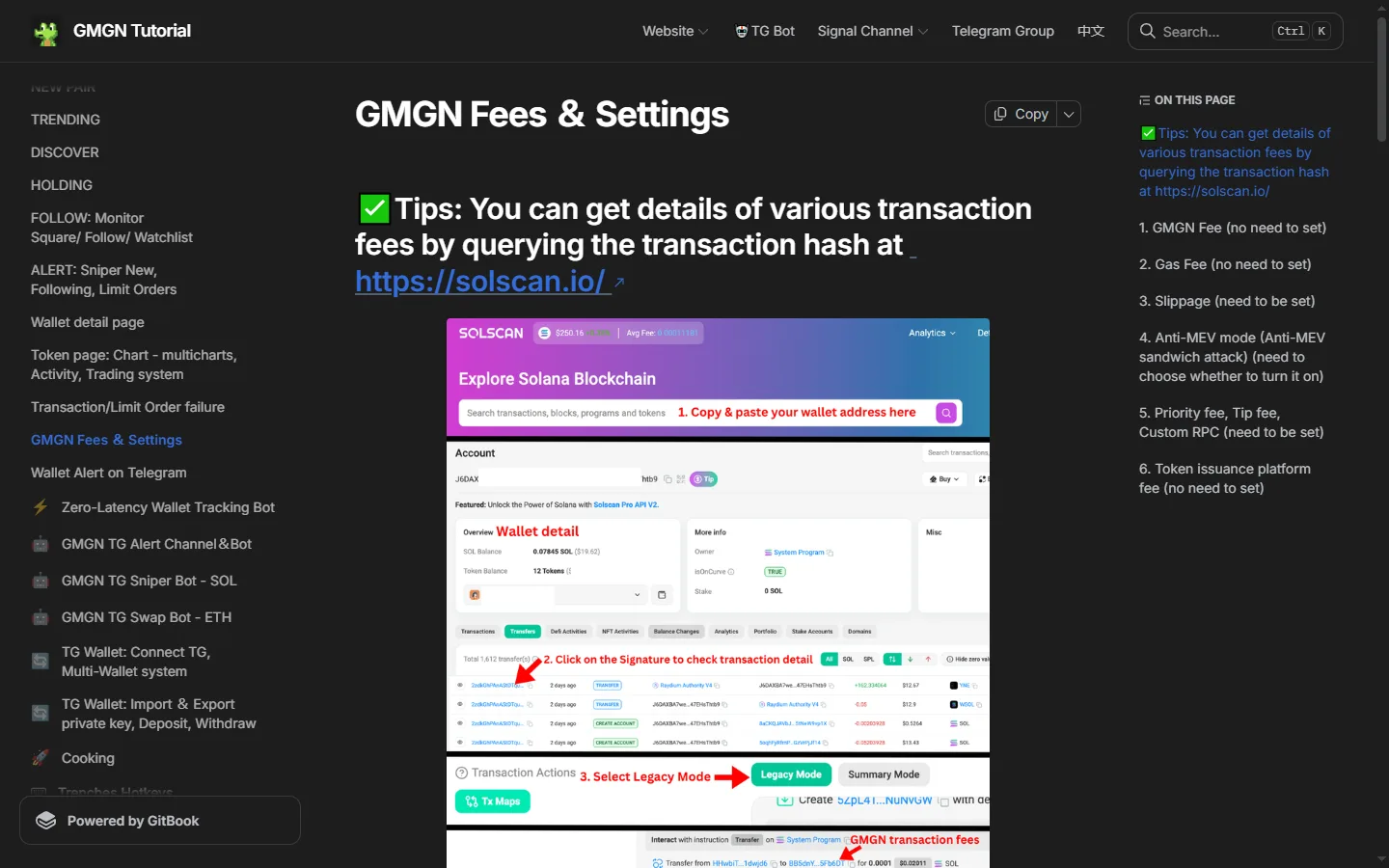
For a trader turning over small positions many times a day, the difference between the PnL panel and the wallet balance grows large enough to look like a bug. GMGN tells you where to reconcile it: query the transaction hash on Solscan, which its fee page recommends in its opening line and its troubleshooting page repeats. The chain shows every fee that was actually paid.
Tip
Before you conclude that a fee is missing, check three things on Solscan for the transaction hash: the priority fee and tip you actually paid, the number of tokens you actually received versus the quote, and whether SOL landed in your wallet as WSOL instead of SOL. GMGN ships a one-click WSOL to SOL converter in the Solana bot's Wallet screen for that last case.
A failed transaction is not a free transaction
Error C1 in GMGN's error table is the one that stings: a transaction that reaches the chain and then fails on slippage. GMGN's own wording is that failure to execute "will consume Gas/priority fee."
That money is gone, and it went to the validator that packed your transaction, not to GMGN. GMGN's position that this is a chain cost rather than a platform charge is accurate, and it is also why a run of failed trades during a volatile minute can drain a wallet with nothing to show for it. Every error code and its fix is broken down in our GMGN transaction failed guide.
How the 1% compares
A 1% flat fee is the sector standard rather than a bargain or a ripoff. Every rate below is quoted from the document linked in its own row, read August 6, 2026. Where we could not reach a primary source for a rebate mechanic, the row says so instead of carrying a number borrowed from a review site. For the same comparison extended to fee revenue and market share across four windows, with the arithmetic printed so you can rerun it, see the terminal fee and market-share snapshot.
| Platform | Documented headline fee | Documented user-side rebate | Source |
|---|---|---|---|
| GMGN | 1% | None documented | docs.gmgn.ai |
| Axiom | 1% base | Tiered SOL cashback to a 0.95%-0.75% net rate, plus 10% off for referred signups | docs.axiom.trade |
| Photon | 1% | None documented | Photon docs |
| Trojan | 1% | A cashback program is widely quoted at 20%; not verified against primary documentation | docs.trojan.com for the rate only |
| BONKbot | 1% | None documented | docs.bonkbot.io |
| Maestro | 1% | None documented; its $200/mo Premium tier is described in terms of features | docs.maestrobots.com |
| Banana Gun | Not verified against primary documentation | Not verified against primary documentation | No reachable primary source |
On documented rates, GMGN sits at the sector standard with no user-facing cashback tier, which puts it slightly behind Axiom. Whether that matters depends on whether you value GMGN's wallet tracking and security scanning more than 0.2% a trade. Our GMGN vs Photon comparison works through that trade-off on the two platforms with identical headline rates.
Does a referral link change your fee?
No, and be careful with anyone who says otherwise. GMGN's documentation describes a referral program that pays the referrer a commission out of the fees GMGN has already collected. We found nothing in that documentation giving the referred user a discount, a rebate or a bonus when we checked on August 6, 2026.
There is one adjacent figure worth reporting precisely. On DefiLlama's GMGN summary, read August 6, 2026, the gap between the fees the adapter recorded and the revenue it attributed to GMGN was about 14.7% all-time. That is the share the adapter does not credit to the platform. Where it actually ends up is a private matter between GMGN and its referrers, and the data does not show it.
That includes our link. Using it costs you nothing and saves you nothing; it pays this site, which is how the research here gets funded. If you want the mechanics of how the codes and commission tiers work, we cover them in the GMGN referral code guide. If a site offers you "80% of your trading fees back," that offer is not part of GMGN's published rate card, so the arrangement behind it, and whether it holds, is a question for the site making it.
Trimming the bill
A short checklist that costs nothing to apply:
- Keep at least 0.05 SOL in the wallet. GMGN's recommended reserve, and the fix for its most common submission failure. A trade that fails on balance still burns fees.
- Match the fee to the trade, not to the recommendation. The 0.006 SOL guidance is written for people whose fills matter more than their fee. If you are buying 0.1 SOL of something nobody is racing you for, 0.002 SOL is the more honest setting.
- Use auto slippage for manual trades. GMGN's own default recommendation. Raise it when you are in a genuine race, then lower it again.
- Turn Anti-MEV on selectively. It costs a 0.002 SOL priority-fee floor. On a meaningful buy into a thin pool that is cheap insurance; on a small one it doubles your cost base.
- Close dust positions. GMGN notes that positions worth under $10 can be closed to reclaim roughly 0.002 SOL of account rent per token account.
- Reconcile on Solscan monthly. Compare what the PnL panel says to what the wallet actually did. The difference is your real fee load.
One more thing worth knowing before you fund an account: GMGN's in-app wallets do not allow private key export, so a GMGN wallet is a hot trading account rather than a place to keep size. We cover the custody model in is GMGN safe, and the setup steps in connect Telegram and fund your GMGN wallet.
Bottom line
GMGN's documented 1% is flat and applied identically across every product, and it is rarely the line item that decides an account. The cost that decides whether you are profitable is the combination of priority fee, tip and slippage that you configure yourself, and the fact that none of it is netted out of the PnL number you look at afterward. Set the on-chain fee to something proportionate to your trade size, keep slippage at auto unless speed genuinely matters, and pull the transaction hash on Solscan the first time a number looks wrong. Open the fee panel before your first buy rather than after it.
Cite this page
These figures are free to quote. Copy the citation or the link below.
Plain-text citation
GMGNGuide. "GMGN Fees Explained: What You Actually Pay in 2026." Published August 6, 2026, updated August 6, 2026. https://gmgnguide.com/guides/fees/gmgn-fees-explainedHTML link
<a href="https://gmgnguide.com/guides/fees/gmgn-fees-explained">GMGN Fees Explained: What You Actually Pay in 2026 — GMGNGuide</a>Embed the GMGN fee table
The attribution line is part of the snippet. Please keep it.
Methodology and reuse
Every rate on this page is read from GMGN's own documentation rather than measured by us: the flat 1% handling fee charged on each transaction across manual trades, sniper trades, copy trades and filled limit orders, the zero fee GMGN charges to launch a token through Cooking, the on-chain formula of priority fee plus tip fee plus gas that GMGN does not collect, the 0.0001 SOL minimum and 2 SOL maximum on each of those, the recommended 0.002 to 0.005 SOL total for unhurried trades and 0.006 SOL or more for automated orders, the 0.002 SOL priority-fee floor Anti-MEV requires, the 0.05 SOL reserve its error documentation recommends, and the slippage guidance of auto for manual trades, 30 to 35% for automated orders and 50% or more for new tokens. Competitor rates are quoted from each platform's own fee page and dated where they appear. The lifetime fee total and the fee-to-revenue gap are computed from the DefiLlama fee adapter at api.llama.fi, which is linked inline with the date it was fetched. The worked cost examples are our own arithmetic on those documented inputs and are labeled as such in the text. They were read from the official GMGN fees and settings documentation on and re-verified against the live app. Exchanges change their schedules, so treat any figure older than that date as needing a fresh check — the date above is the one to compare against.
You may republish these figures with attribution and a link to https://gmgnguide.com/guides/fees/gmgn-fees-explained.
Set your fees before your first trade
GMGN charges 1% flat on every buy and sell. Priority fee, tip and slippage are yours to set, and they are what decide your real cost. Not financial advice.
Get Started on GMGNFrequently Asked Questions
GMGN's published fee page documents a flat 1% handling fee on every transaction, buy and sell alike. It states that there are no additional charges, and the worked example given is a 1 SOL trade paying 0.01 SOL. That documentation describes no sniper surcharge, no copy-trading surcharge, no subscription tier and no GMGN fee for launching a token through Cooking, checked 6 August 2026. Priority fees, tip fees and network gas are separate line items that GMGN's docs say it does not collect.
Almost always because of your own settings. Priority fee and tip fee are user-set and go to validators and private nodes, not to GMGN, and GMGN recommends 0.006 SOL or more for automated orders. On a 0.1 SOL trade that is 6% on the buy alone. Slippage is the bigger cost: GMGN recommends 30 to 35% for automated orders and 50% or more for new tokens, which authorizes execution far below the quoted price on an illiquid token.
No. GMGN's documentation states plainly that priority and tip fees are paid to speed up transaction processing and are not collected by GMGN. The priority fee goes to Solana validators for faster confirmation and the tip fee goes to private nodes. Both have a minimum of 0.0001 SOL and a maximum of 2 SOL. Network gas is likewise a chain cost, not a GMGN cost.
GMGN's documented PnL formula is total profit equals realized profit plus unrealized profit, with no fee term in it. Treat the PnL number as a price-based figure rather than a full accounting of a trade. Your 1% handling fee, priority fee, tip and slippage cost are not broken out for you. To reconcile what a trade really cost, look up the transaction hash on Solscan, which is what GMGN's own documentation tells users to do.
No. GMGN's documentation describes a referral program that pays the referrer a commission out of the fees GMGN collects. Its published fee schedule shows one rate, and we found no documented discount, rebate or bonus for the referred user anywhere in that documentation when we checked on 6 August 2026. If you see a GMGN fee discount advertised somewhere, it is not coming from GMGN's published rate card, so ask whoever is offering it exactly what they are paying and out of what. Your fee to GMGN is 1% either way.
GMGNGuide is an independent reference published by a third party. It is not affiliated with, produced by, reviewed by, endorsed by or sponsored by GMGN.AI, GraceMatrix Technologies Limited, GMGN Labs Limited, or any of their affiliates. "GMGN" and GMGN's logo are trademarks of their respective owners and are used here only to identify the product this site writes about.
Disclaimer: Nothing on this site is legal, tax, financial or investment advice, and nothing here is a statement about whether any activity is lawful or how it should be taxed where you live. Trading memecoins carries a substantial risk of total loss. Verify anything that matters against GMGN's own documentation and consult a professional qualified in your jurisdiction. Most participants in these markets lose money, and past performance says nothing about future results. This site contains referral links, and GMGN pays us a share of the fees you pay without giving you a discount. See our disclosure for details.
Ready to Start Trading?
GMGN charges a flat 1% per trade across Solana, BSC, Ethereum, Base and Tron. Connect Telegram, fund the wallet, and set your slippage and priority fee before your first buy.
Open GMGN