GMGN Glossary: Every Term in the Terminal, Explained
Table of Contents
- Terms in the Trenches feed
- Trenches
- Snipe, sniper
- Dev, and "dev sold"
- Bundled, bundler
- Insiders
- Top 10 holders
- Smart money
- KOL
- Rug, rug probability, rug history
- Terms in the contract security panel
- Mint authority, MintDisable
- Blacklist
- LP burned, Burnt
- Honeypot
- Terms in the trade panel and its settings
- Slippage
- Priority fee
- Tip
- Anti-MEV
- Copy trading
- The error you will actually paste into a search
- No available router
- How this page is maintained
 GMGN
GMGN
Generic crypto glossaries will tell you what a honeypot is. None of them tells you what GMGN's honeypot flag actually screens for, which chain it applies to, or which panel it sits in. That gap is the reason people end up searching for things like "gmgn dev sell all meaning" and "gmgn bundle check" instead of finding an answer.
This page defines the vocabulary the GMGN interface itself uses, grouped by the panel each term appears in rather than alphabetically, because that is how you meet them. Every definition is taken from GMGN's own documentation at docs.gmgn.ai, read on 25 August 2026, and where GMGN does not define something precisely, this page says so rather than filling the gap.
GMGN's security checks carry an explicit disclaimer from GMGN itself: they are "for reference only and cannot guarantee 100% accuracy," and GMGN advises comparing several tools before trading. Read every flag below as a prompt to look closer. None of them is a verdict, and a token can pass all of them and still go to zero.
Terms in the Trenches feed
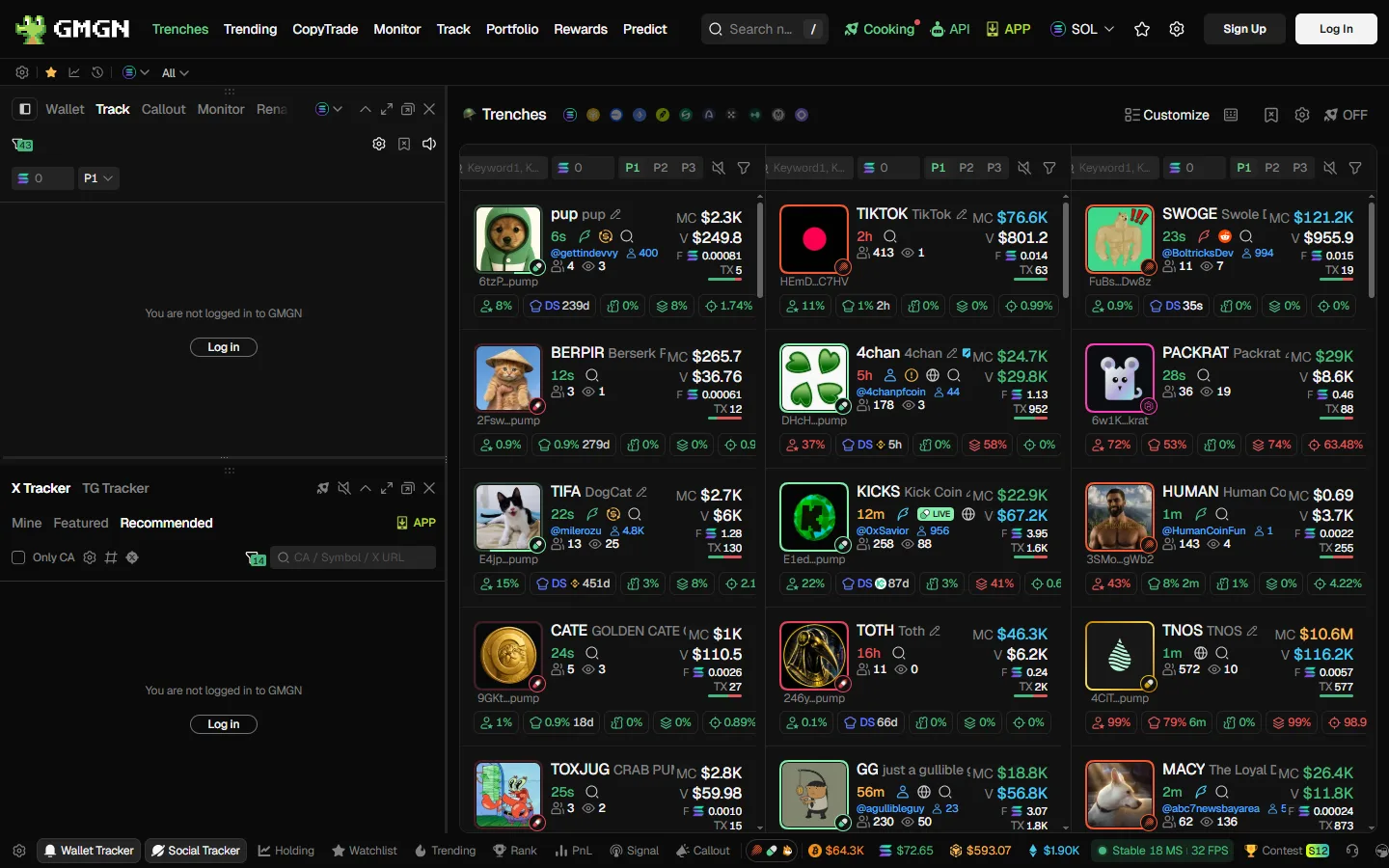
The Trenches feed is GMGN's home screen, and most of these labels appear on the token cards inside it or on the token page one click away.
Trenches
GMGN's live feed of brand-new tokens, and the page the terminal opens on. It runs as columns of New, Almost bonded and Migrated tokens, which track a launchpad token's life from creation, through the bonding-curve threshold, to a real DEX pool. The same three tabs survive on a phone, stacked into one column.
The thing to understand about it is that it is a firehose rather than a shortlist. Nothing in it has been curated, and the trenches and sniper guide covers the filters that make it usable.
Snipe, sniper
To snipe is to buy a token within the first few blocks of trading opening. GMGN uses Snipers as a wallet label, defined in its documentation as "buyers who purchased within the first few blocks after trading opened," and shows how many there are and what share of supply they hold.
It is a statement about timing, not about intent. What it tells you is how much of the supply sits with wallets whose cost basis is far below anything you can get, which is supply that can be sold into your entry.
Dev, and "dev sold"
DEV on a token card is the creator wallet's holding as a percentage of supply. "Dev sold" is trader shorthand rather than a GMGN label: what the interface actually shows is a holding status on the wallet, drawn from a documented set of five. Hold means the wallet still has what it first bought. Buy More means it added. Sell Part means it sold some and still holds. Sell All means the whole initial buy is gone. Transferred means nothing was sold but some was moved out.
GMGN adds a caveat worth carrying: on Solana it is "temporarily impossible to distinguish between transferred and sold tokens," so Sell Part is doing some guessing.
Bundled, bundler
GMGN advertises a bundle buy ratio as one of its computed metrics, and a Bundler figure appears on the token page. A bundle in this context is a set of buys submitted together in one transaction bundle at launch, which is how a creator can seed several wallets with supply before anyone else can trade.
Being honest about the limit here: GMGN's published documentation does not define how it calculates the ratio, so treat the number as GMGN's own measure rather than a standard one. A high reading means a lot of the early supply arrived in one coordinated action.
Insiders
Precisely defined by GMGN, and more specific than the word suggests: wallets that did not buy tokens after trading opened, but hold tokens. GMGN's documentation says that pattern may indicate the creator's holdings were transferred to multiple wallets to be sold off quietly, and points out that legitimate projects usually distribute that way through an announced airdrop, so checking the project's X account is the first move.
The insider trading holder ratio is those wallets' holdings as a share of total supply. GMGN's own line: the higher the ratio, the more concerning it is.
Top 10 holders
The wallets currently ranked in the top ten by holding size, excluding liquidity pool addresses, with the list changing in real time. The figure shown is what those ten currently hold as a share of total supply.
It also appears as a pass or fail on the Solana security panel, where GMGN's threshold is explicit: Top10 hold reads "Yes," meaning relatively safe, when the top ten hold less than 30% of supply.
Smart money
GMGN's term for wallets its Discover leaderboards rank as consistently profitable. The leaderboards carry 1-day, 7-day and 30-day profit and loss, a 7-day win rate, 7-day transaction counts and 7-day average cost.
It is a performance label derived from history, and the copy trading guide works through why a wallet earning that label is not automatically a wallet worth mirroring.
KOL
Key opinion leader, the crypto sector's term for an influencer. It shows up in two places on GMGN. In the X Tracker, which curates over 2,000 X accounts, KOL is one of the three account labels alongside Master and Trader. And in GMGN's referral program, where its application form says GMGN "provides competitive rebate rates for KOLs" without publishing the volume thresholds.
Both usages describe reach rather than accuracy. Our referral code page covers the rebate side of it, including what the referred user does and does not get.
Rug, rug probability, rug history
A rug is a launch whose creator pulls liquidity or dumps supply, leaving buyers with a token nobody will trade. GMGN turns it into two separate readings on the Solana security panel.
Rug probability is derived from the holder set: GMGN describes it as analyzing holders, where "the more holders who frequently buy rug pull tokens, the higher the likelihood that this token could be a rug pull." Rug history is about the creator instead, showing which previous rug pulls may have come from the same wallet.
They answer different questions, and rug history is the harder one to argue with.
Read the Panel Before You Read the Chart
Every check on this page renders on the token screen before you buy. GMGN charges a flat 1% per transaction, and the settings you pick around it cost more than the fee does. Our link carries code ggguide, which pays us a share of the fee you pay and changes nothing about your rate.
Open GMGNTerms in the contract security panel
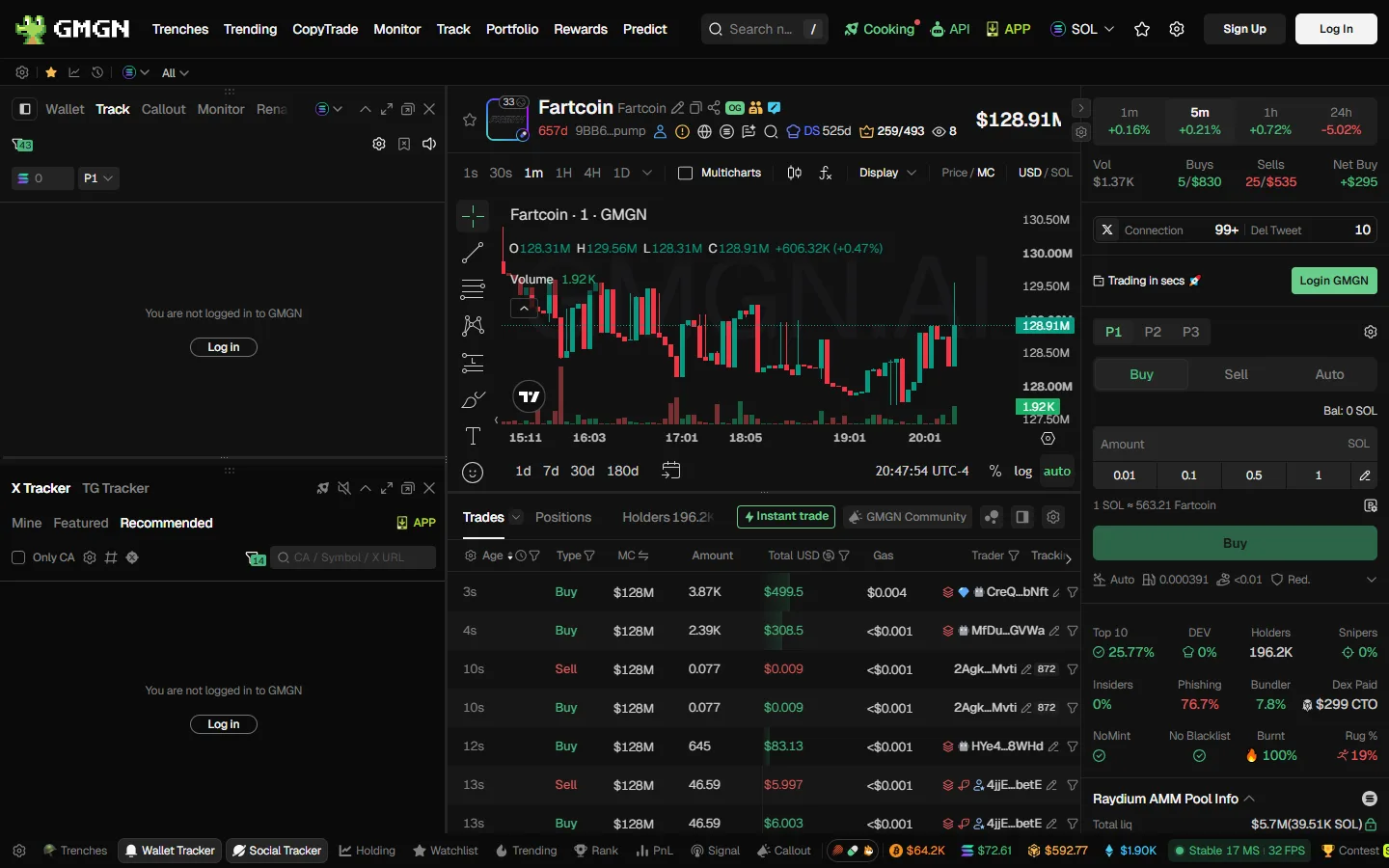
These sit in a compact grid on the token page. GMGN runs a different set per chain, which is why some of these appear on a Solana token and not on an Ethereum one.
Mint authority, MintDisable
Whether the token's creator can still issue new supply. GMGN shows it as MintDisable, and its wording is that "Yes" indicates safety, meaning that the token creator cannot issue additional tokens to manipulate the market.
This is the check with the least ambiguity in it. Mint authority is either revoked on-chain or it is not.
Blacklist
Whether the project can block specific wallets from transacting. GMGN's reading is inverted from the others, so read it carefully: "No" indicates safety, meaning the project cannot blacklist anyone's transactions.
If it reads "Yes," GMGN's documentation is blunt about what that means for you: you are on that token dev's blacklist, you cannot sell, and the app will tell you your wallet is frozen. That is also error B4 when a sell fails.
LP burned, Burnt
The share of the liquidity pool that has been burned, shown as a percentage. GMGN's guidance is that the higher the better, with 100% meaning the project cannot withdraw from the liquidity pool.
On the Ethereum-side checks the same idea appears as Locked/Burned, and the distinction there matters: locked LP tokens can be retrieved when the lock expires, burned ones have gone to an address nobody controls.
Honeypot
A token you can buy and cannot sell. GMGN's definition: when the check reads "Yes," the creator "uses technical measures to restrict the sale of tokens." It appears on the Ethereum-side checks rather than the Solana ones, where an extreme sell tax does the same job and shows up under Buy/Sell Tax instead. GMGN's own example of the giveaway is a 99% sell tax.
Two caveats GMGN publishes and most write-ups drop. The detection is not GMGN's own: it "relies on third-party data sources such as Goplus," and GMGN says the display may lag, so it does not guarantee timeliness or accuracy. And a contract can show as renounced and still be updated into a honeypot afterwards.
A sell blocked by a honeypot is error B4, and GMGN's stated outcome for it is that the token cannot be sold. Not "try a higher slippage." Cannot.
Terms in the trade panel and its settings
These are the controls sitting under the Buy button, and between them they decide most of what a trade actually costs. All the figures below come from GMGN's fees and settings documentation.
Slippage
The price movement you authorize between quoting a trade and filling it. It is a tolerance you grant, not a fee anyone charges, which is exactly why it is the largest hidden cost on an illiquid token: a 50% setting authorizes a fill half a level below what you were shown.
GMGN's own guidance is 30 to 35% for automated orders and 50% or more on new tokens. Too low and the trade fails on slippage, which is error C1 and still burns gas. The fee breakdown prices what that trade-off costs in practice.
Priority fee
An amount you attach to a Solana transaction to get validators to process it sooner. Minimum 0.0001 SOL, maximum 2 SOL, and GMGN's documentation states it is not collected by GMGN: it goes to validators.
That last part has a consequence people discover the hard way. Because GMGN never receives the money, nobody at GMGN is positioned to refund a mis-set priority fee, and GMGN's own Q&A carries a case of a user who sold 0.12 SOL of tokens while paying a 0.2 SOL priority fee.
Tip
The same shape of payment, aimed at private nodes rather than validators. Minimum 0.0001 SOL, maximum 2 SOL, also not collected by GMGN. GMGN's guidance treats the priority fee and the tip together as a single "total on-chain fee" figure, recommending 0.002 to 0.005 SOL when speed does not matter and 0.006 SOL or more for auto buy, auto sell and limit orders.
Those are flat amounts rather than percentages, which is what makes them punishing on small trades.
Anti-MEV
GMGN's protection against sandwich bots front-running your buy. It has a price floor: enabling it requires a priority fee of at least 0.002 SOL, plus a minimum tip. GMGN documents three submission modes: off protection sends to all nodes and is fastest, reduced protection sends to limited nodes and may still be front-run, and secure protection sends to safe nodes, is slightly slower, and carries compensation.
It is also the one thing GMGN attributes an RPC failure to. Error codes A3 and H3 both read "Anti-MEV RPC service failure," and GMGN's documented fix for both is to switch it off rather than to add an endpoint of your own, which is worked through in how to set a custom RPC.
Copy trading
A task that mirrors another wallet's trades into yours automatically. The documented limits are narrower than most descriptions admit: it is Solana only, it requires a Telegram login, and you can run at most 10 tasks. After three consecutive failed transactions a task pauses itself and does not restart on its own.
It costs the standard flat 1% per mirrored transaction, on the buy and again on the sell, plus your own on-chain fee on both legs.
The error you will actually paste into a search
No available router
GMGN's message for a trade that never reached the chain because there was no route to trade through. The raw string in the Telegram wallet is trade_error_40002700, and GMGN's failure documentation maps it to three separate causes:
- D1 The creator or project removed liquidity, so no route exists. GMGN's advice is to confirm the pool was burned before trading, because once it is removed, trading is over.
- D2 A Pump.fun, Moonshot or similar token that has hit the $69K threshold and is untradeable while the Raydium or Meteora pool is being opened. This one resolves by itself; you wait.
- D3 Solana congestion, or a problem at the node provider.
Only D2 fixes itself. The failed transaction guide covers the full code table, including the limit-order variant order10013, which maps to the routing codes L1 to L3 instead.
How this page is maintained
Every definition above is taken from GMGN's published documentation at docs.gmgn.ai, read on 25 August 2026, and cross-checked against the interface as it renders in the captures on this page. Terms are added when they appear in the product, not when they appear in a generic crypto dictionary, and anything GMGN does not define precisely is marked as such rather than guessed at. If a label changes in the app, the entry changes here, and the updated date at the top of the page is the one to check against.
Interface labels move faster than documentation does. If you are looking at a flag this page does not carry, GMGN's own docs index is the place to start, and the what is GMGN explainer covers the product surfaces these terms belong to.
Cite this page
These figures are free to quote. Copy the citation or the link below.
Plain-text citation
GMGNGuide. "GMGN Glossary: Every Term in the Terminal, Explained." Published August 25, 2026, updated August 25, 2026. https://gmgnguide.com/ecosystem/gmgn-glossaryHTML link
<a href="https://gmgnguide.com/ecosystem/gmgn-glossary">GMGN Glossary: Every Term in the Terminal, Explained — GMGNGuide</a>Methodology and reuse
The definitions and thresholds on this page are GMGN's own: the 30% top-ten holder threshold, the 0.0001 to 2 SOL priority fee and tip range, the 0.002 SOL Anti-MEV floor, the 30 to 35% and 50% slippage guidance, the 10-task copy trading cap and the D1 to D3 routing codes. They were read from the official GMGN documentation on and re-verified against the live app. Exchanges change their schedules, so treat any figure older than that date as needing a fresh check — the date above is the one to compare against.
You may republish these figures with attribution and a link to https://gmgnguide.com/ecosystem/gmgn-glossary.
Frequently Asked Questions
GMGN defines insider trading wallets as wallets that did not buy the token after trading opened but hold it anyway. Its documentation says that pattern may indicate the creator's holdings were spread across several wallets to be sold off quietly, and notes that legitimate projects usually distribute that way through announced airdrops. The insider ratio shown on the token page is those wallets' holdings as a share of total supply, and GMGN says the higher it reads, the more concerning it is.
GMGN labels snipers as wallets that bought within the first few blocks after trading opened, and shows the count and the share of supply they hold on the token page. It is a description of timing rather than a verdict. What it tells you is how much supply sits with buyers whose average cost is far below yours, since those wallets can exit into your entry.
Burnt is the percentage of the liquidity pool that has been burned. GMGN's own wording is that the higher the ratio the better, and that 100% means the project cannot withdraw from the liquidity pool. On the Ethereum-side checks the same idea appears as Locked/Burned, where locked LP tokens can be retrieved when the lock expires and burned ones cannot.
It is GMGN's error for a trade that never reached the chain because no route existed. The raw string is trade_error_40002700 and its documentation maps it to three causes: D1, the creator removed liquidity so no route exists; D2, a Pump.fun or Moonshot token sitting in the migration window around the $69K threshold while the Raydium or Meteora pool opens; and D3, Solana congestion or a node-provider problem. Only D2 resolves on its own.
No, and it says so at the top of the page that documents them: the checks are for reference only and cannot guarantee 100% accuracy, and GMGN advises comparing several security tools before trading. The honeypot check specifically relies on third-party data from GoPlus and GMGN says it may display with some delay. Treat every flag on this page as a signal to look closer, not as a verdict.
GMGNGuide is an independent reference published by a third party. It is not affiliated with, produced by, reviewed by, endorsed by or sponsored by GMGN.AI, GraceMatrix Technologies Limited, GMGN Labs Limited, or any of their affiliates. "GMGN" and GMGN's logo are trademarks of their respective owners and are used here only to identify the product this site writes about.
Disclaimer: Nothing on this site is legal, tax, financial or investment advice, and nothing here is a statement about whether any activity is lawful or how it should be taxed where you live. Trading memecoins carries a substantial risk of total loss. Verify anything that matters against GMGN's own documentation and consult a professional qualified in your jurisdiction. Most participants in these markets lose money, and past performance says nothing about future results. This site contains referral links, and GMGN pays us a share of the fees you pay without giving you a discount. See our disclosure for details.
Ready to Start Trading?
GMGN charges a flat 1% per trade across Solana, BSC, Ethereum, Base and Tron. Connect Telegram, fund the wallet, and set your slippage and priority fee before your first buy.
Open GMGN